
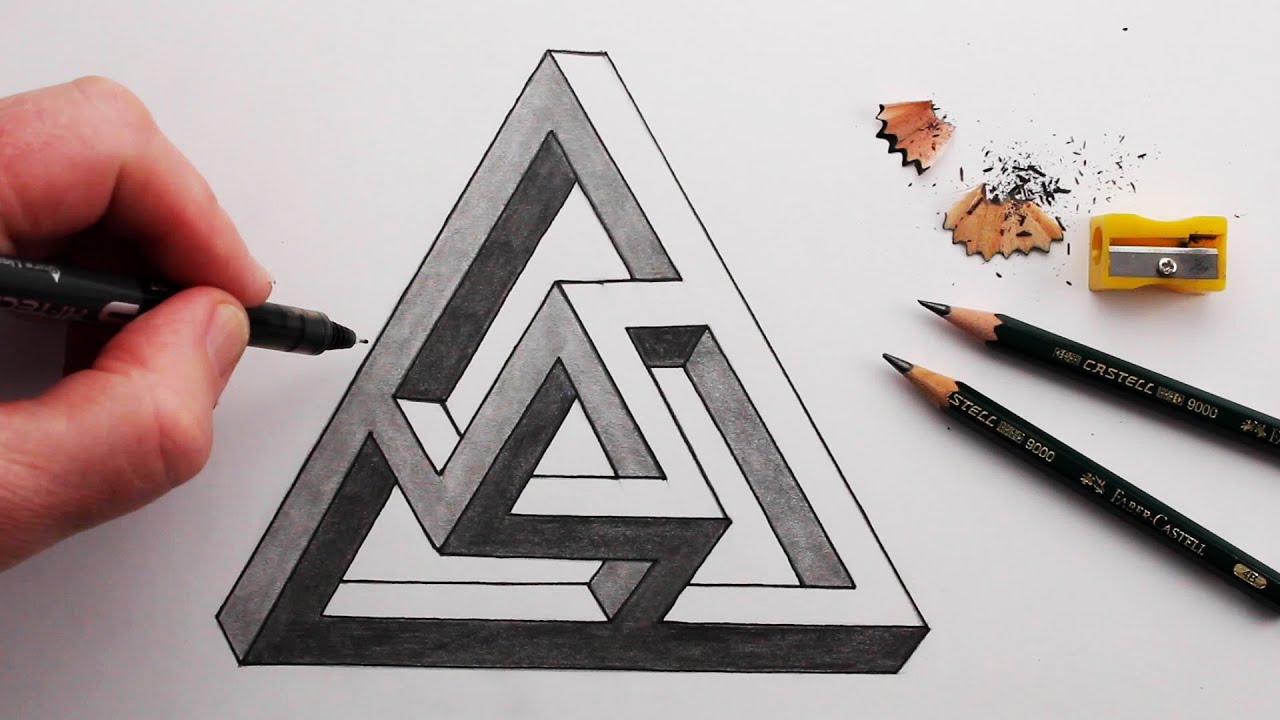
The impossible triangle is one of the most famous optical illusions in the world, and it keeps confusing people even today. At first glance, it looks like a simple 3D triangle made from solid beams. However, when you try to understand how it exists, your brain gets stuck because the structure cannot physically exist in real life. This strange shape is also known as the Penrose triangle, and it shows how powerful visual tricks can be when they are drawn on a flat surface.
The reason the impossible triangle is so popular is because it feels real for a few seconds. Your eyes accept it without question, and only later does your mind notice something is wrong. This creates curiosity and surprise. That is why artists, teachers, and even scientists use the impossible triangle to explain how human perception works and how easily the brain can be fooled by perspective.
In this article, we will explore the impossible triangle in simple words. We will talk about its meaning, its history, how it works, and why it is still important today. Everything is explained in an easy style so even young learners can understand it clearly without confusion.
What Is the Impossible Triangle?
The impossible triangle is a special shape that looks like a real object at first but cannot exist in three-dimensional space. It appears as if three straight beams are connected to form a triangle, yet the connections do not make logical sense when you follow them step by step. This is why it is called “impossible,” because no real material could be shaped like this without breaking the rules of geometry.
When you look at the impossible triangle, your brain tries to interpret it as a solid structure. Each corner seems normal on its own, and each line looks correct. However, when you trace the full shape, you find that the ends do not match in a physically possible way. This confusion happens because your mind is trained to understand depth, even when the image is flat.
Another important thing about the impossible triangle is that it only exists in drawings. You cannot build it with wood, metal, or plastic in real life. It only works on paper or screens because it depends on forced perspective. That is why it is considered an optical illusion instead of a real object.
The impossible triangle is also known as the Penrose triangle, named after the mathematicians who helped develop the idea. Over time, it became a symbol of visual illusion, creativity, and the limits of human perception.
History of the Impossible Triangle
The impossible triangle has an interesting history that started in the 20th century. It was first introduced by mathematicians Lionel Penrose and Roger Penrose. They were studying how the human brain understands shapes and geometry. During their work, they discovered that it was possible to create drawings that look real but cannot exist in physical space.
The impossible triangle was one of their most famous discoveries. It showed that people can be tricked by simple lines arranged in a clever way. Once the idea was published, it quickly caught attention in both science and art communities. Many people were surprised that something so simple could confuse the mind so deeply.
Later, the idea became even more popular because of artists like M.C. Escher. He used similar impossible structures in his artwork. His drawings showed endless stairs, looping buildings, and strange shapes like the impossible triangle. These artworks made people more curious about how perception works and why the brain accepts impossible visuals.
Today, the impossible triangle is widely used in education, psychology, and design. It is often shown in classrooms to explain optical illusions. It also appears in logos, tattoos, and modern digital art. Its history shows how a simple mathematical idea can become a global visual icon.
How the Impossible Triangle Works
The impossible triangle works by tricking your brain’s sense of depth and perspective. When you see a drawing, your eyes only capture a flat image. But your brain automatically tries to convert it into a 3D object. This natural process is helpful in real life, but it can also create illusions when the drawing is carefully designed.
In the case of the impossible triangle, each part of the shape is drawn using correct perspective rules. So every corner looks believable on its own. However, when all parts are combined, the structure becomes logically impossible. Your brain tries to connect the pieces, but it fails because the depth information contradicts itself.
This is why the impossible triangle feels so strange. It is not broken drawing; it is a clever arrangement of correct lines placed in a misleading way. The illusion works best when viewed from a specific angle. If you rotate or change the perspective, the illusion disappears immediately.
Another reason the impossible triangle works is because the brain fills in missing information. Humans are good at guessing shapes quickly. So when something looks “almost correct,” the mind accepts it as real. This is what makes the impossible triangle such a powerful example of visual perception errors.
Why the Impossible Triangle Confuses the Brain
The impossible triangle confuses the brain because it mixes two different realities: 2D drawings and 3D interpretation. Your eyes see flat lines on a page, but your brain insists that those lines must belong to a real object in space. This mismatch creates confusion.
Another reason the impossible triangle is so tricky is because each section individually makes sense. Nothing looks wrong when you focus on one corner. But when your brain tries to combine everything into one solid object, the logic breaks. This creates a loop of confusion that your mind cannot solve.
The impossible triangle also shows how much humans depend on visual shortcuts. Instead of checking every detail carefully, the brain often makes quick assumptions. This helps us understand the world faster, but it also makes us vulnerable to illusions like this one.
Because of these effects, the impossible triangle is often used in psychology studies. It helps researchers understand how humans process visual information and why our perception is not always accurate.
Uses of the Impossible Triangle in Real Life
The impossible triangle is not just a fun drawing. It has many real-life uses in education, art, and design. Teachers often use it to explain geometry and perspective in a simple and interesting way. Students learn how 3D shapes are formed and why some structures cannot exist in reality.
In art, the impossible triangle is used to create creative and mind-bending designs. Many artists include it in paintings, digital graphics, and street art. It makes their work stand out because it surprises viewers and makes them think deeply.
The impossible triangle is also used in logos and branding. Some companies use it to represent creativity, innovation, and imagination. Its strange but balanced look makes it memorable and visually appealing.
In addition, the impossible triangle appears in puzzles, games, and animations. It challenges people to think differently and understand visual tricks. This makes it both educational and entertaining at the same time.
Fun Facts About the Impossible Triangle
The impossible triangle is full of interesting facts that make it even more fascinating. First, it cannot be built in real life, no matter what materials you use. It only works in drawings and digital images.
Second, the impossible triangle is part of a bigger group of illusions called “impossible objects.” These include impossible stairs and impossible cubes. All of them play with perspective in similar ways.
Third, the impossible triangle is often used in brain tests and visual experiments. It helps scientists study how people interpret shapes and depth.
Finally, the impossible triangle has become a symbol of imagination. It reminds us that not everything we see is always real, and sometimes the mind creates its own version of reality.
FAQs
1. Why is it called the impossible triangle?
It is called impossible because it cannot exist in real 3D space, even though it looks real in drawings.
2. Who invented the impossible triangle?
It was developed by Lionel Penrose and Roger Penrose as part of mathematical studies.
3. Can we build the impossible triangle in real life?
No, it cannot be physically built because its structure breaks geometric rules.
4. Why does the impossible triangle look real?
It looks real because the brain tries to interpret 2D drawings as 3D objects.
5. Where do we see the impossible triangle today?
It appears in art, education, puzzles, logos, and optical illusion designs.
Conclusion
The impossible triangle is a powerful example of how the human mind can be tricked by simple lines. It looks real, but it cannot exist in the physical world. This makes it both confusing and fascinating at the same time.
From mathematics to art, the impossible triangle has influenced many fields. It teaches us about perception, logic, and imagination. Most importantly, it shows that our eyes do not always tell the full truth.
Even today, the impossible triangle continues to inspire curiosity. It reminds us that the world of illusions is full of surprises, and sometimes, what we see is not what is truly real.
